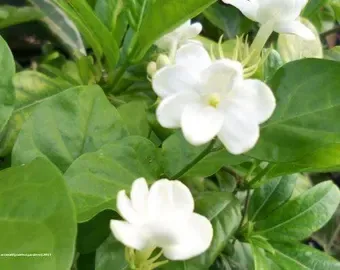
Maid of Orleans is a single petal cultivar of Jasminum sambac. Unlike double varieties, its flowers open fully and cleanly, releasing fragrance early and reliably. It grows as a compact shrub and responds well to regular care and light harvesting.
Why people grow it
- Abundant flowering: blooms readily in warm conditions
- True jasmine scent: clear, sweet, and immediately recognizable
- Forgiving growth habit: suitable for patios and containers
- Everyday usability: flowers can be enjoyed often, not rationed
This is the jasmine that teaches people why jasmine matters.
Cultural presence
Single petal sambac jasmines like Maid of Orleans are widely used across India and Southeast Asia for daily wear, offerings, and home fragrance. This is the jasmine woven into hair, placed near doorways, and picked without ceremony because the ceremony is life itself.
It does not announce itself as rare or special. It simply shows up, again and again.
What to expect
Maid of Orleans grows steadily and blooms more consistently than double petal jasmines. It responds well to warmth, sun, and gentle pruning. Flowering improves with maturity but does not require years of patience.
If you want reassurance that jasmine will perform, this is the one.
How we approach it at Tulsi Grove
We treat Maid of Orleans as a foundational jasmine, not a filler plant. It anchors our jasmine line and sets expectations honestly. When someone asks what jasmine smells like, this is the answer we trust.
Disambiguation & Notes
- Single petal, not double: fragrance comes early and clean
- Often confused with Arabian Jasmine generically: cultivar matters
- More forgiving than Grand Duke of Tuscany: less sulking, more blooming
- Excellent reference plant: useful for understanding other jasmines
Practical Tips
- Bright light improves flowering
- Warm nights matter
- Water consistently, avoid cycles of neglect and correction
- Light pruning encourages branching and buds
- Pick flowers often, the plant responds positively