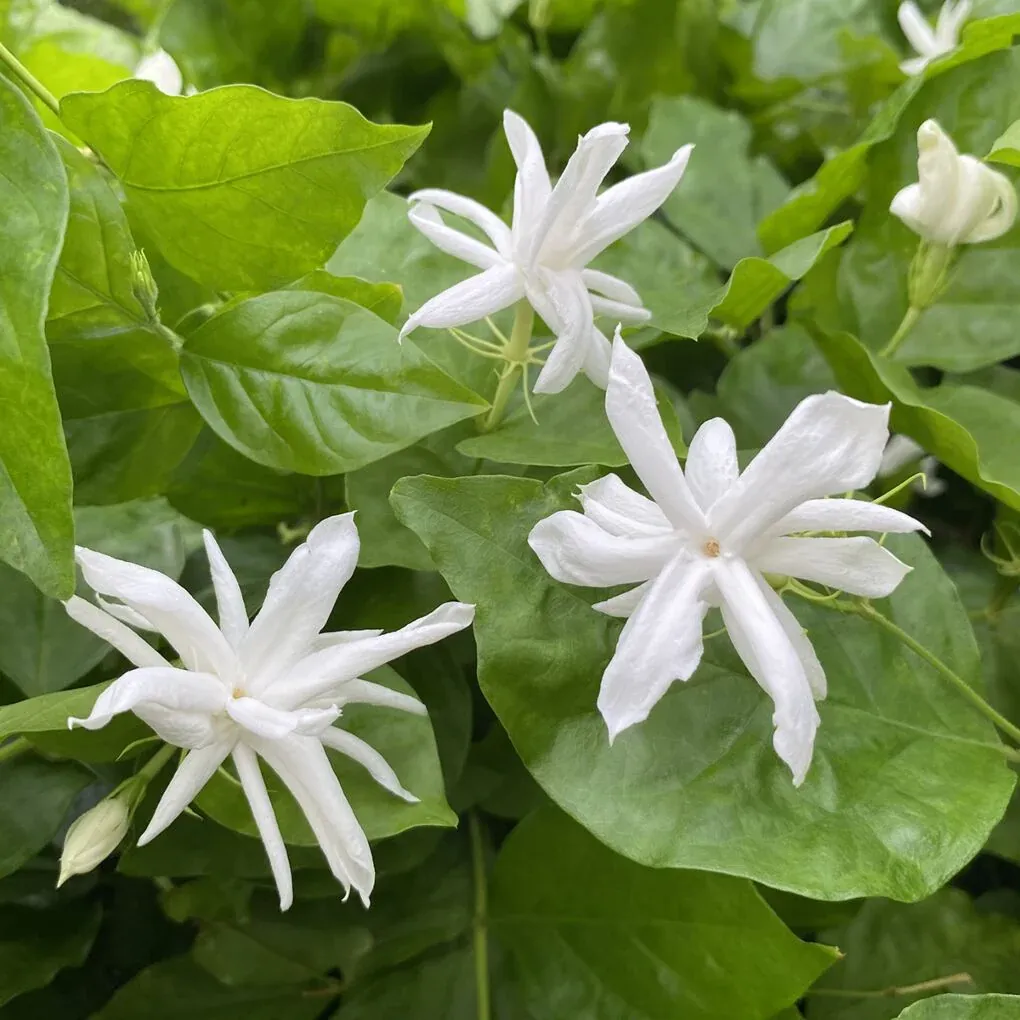
Belle of India is a form of Jasminum multiflorum, grown as a shrub rather than a vine. It produces clusters of starry white flowers, often in quantity, and maintains a tidy structure with minimal effort.
This is a jasmine that prioritizes consistency over drama.
Why people grow it
- Prolific blooming: flowers appear in clusters, often repeatedly
- Low fuss: forgiving of missed perfection
- Clean white presence: visually calming, works in many settings
- Good structure: looks composed even between bloom cycles
It is the jasmine you plant when you want success without micromanagement.
Cultural presence
Belle of India belongs to the everyday visual language of Indian gardens. It lines walkways, fills hedges, and shows up where white flowers are needed in quantity, homes, schools, temples, and public spaces.
It is not the jasmine of songs or cinema. It is the jasmine of lived spaces.
What to expect
This plant grows steadily into a compact shrub. Flowering improves with sun and maturity. The fragrance is present but gentler than sambac types, noticeable when close, pleasant rather than overpowering.
It rewards space and light more than attention.
How we approach it at Tulsi Grove
We treat Belle of India as a backbone jasmine. It belongs in courtyards and along edges where consistency matters. This is not a collector’s jasmine. It is a keeper’s jasmine.
Disambiguation & Notes
- Often confused with other white jasmines: bloom form and growth habit matter
- Less intense fragrance than sambac: choose accordingly
- Shrub, not vine: no trellis needed
- Excellent for hedging and mass planting
Practical Tips
- Full sun to bright light improves flowering
- Prune lightly to maintain shape and encourage new growth
- Water regularly, avoid soggy soil
- Performs well in warm climates
- Give it space to widen naturally